Artificial intelligence is no longer a futuristic concept reserved for tech giants and research labs. It’s transforming industries, creating new career opportunities, and changing the way businesses operate. As a result, more people than ever are exploring careers in AI. The challenge, however, is knowing where to begin.
If you’ve searched online for AI learning paths, you’ve probably come across countless tutorials, certifications, and conflicting advice. That’s where the Droven.io AI Career Roadmap comes in. Instead of jumping from one resource to another, this roadmap provides a structured approach to building the skills needed to succeed in the AI industry.
Whether you’re a student, a working professional looking for a career switch, or simply curious about artificial intelligence, this guide will help you understand how to follow the roadmap and improve your chances of landing an AI job in 2026.
What Is the Droven.io AI Career Roadmap?
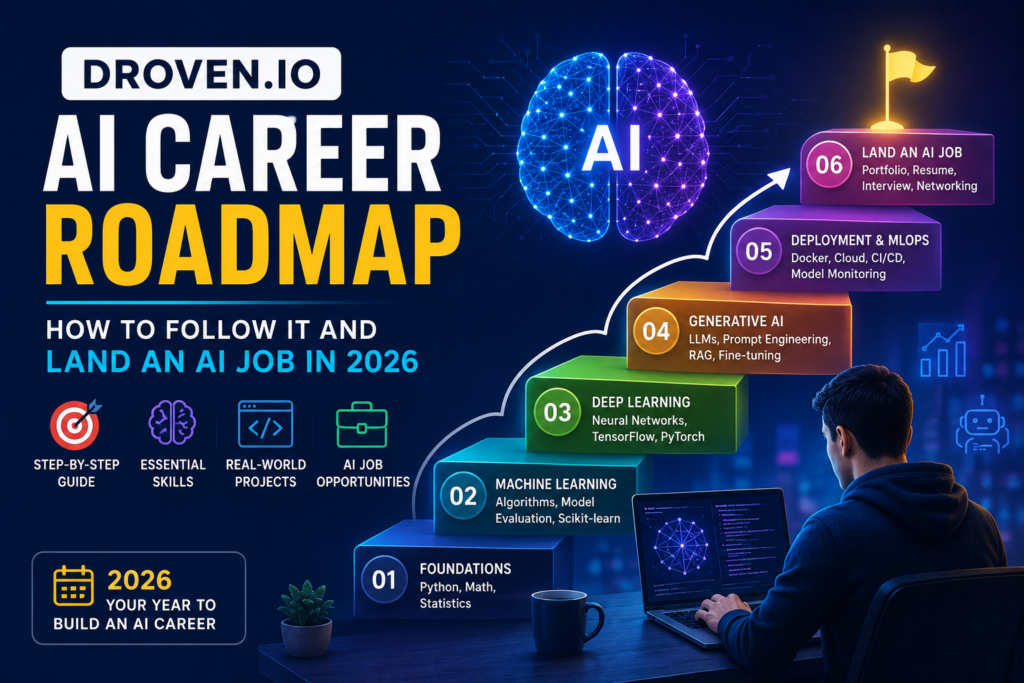
The Droven.io AI Career Roadmap is commonly discussed as a step-by-step framework designed to help aspiring professionals navigate the world of artificial intelligence. Rather than focusing on a single course or certification, it emphasizes learning essential concepts in the right order.
The idea behind the roadmap is simple: build a strong foundation, develop practical skills, create projects, and prepare yourself for real-world AI roles.
For many beginners, the biggest obstacle isn’t a lack of motivation—it’s the overwhelming amount of information available online. A roadmap helps eliminate confusion by showing exactly what to learn and when to learn it.
Why Following a Roadmap Matters
Artificial intelligence is a broad field. Without direction, it’s easy to spend months watching random tutorials without making meaningful progress.
A structured roadmap helps you:
- Focus on relevant skills.
- Avoid unnecessary distractions.
- Build confidence through measurable milestones.
- Develop a portfolio that employers value.
- Prepare for specific AI career paths.
In other words, a roadmap transforms your learning journey from guesswork into a strategic plan.
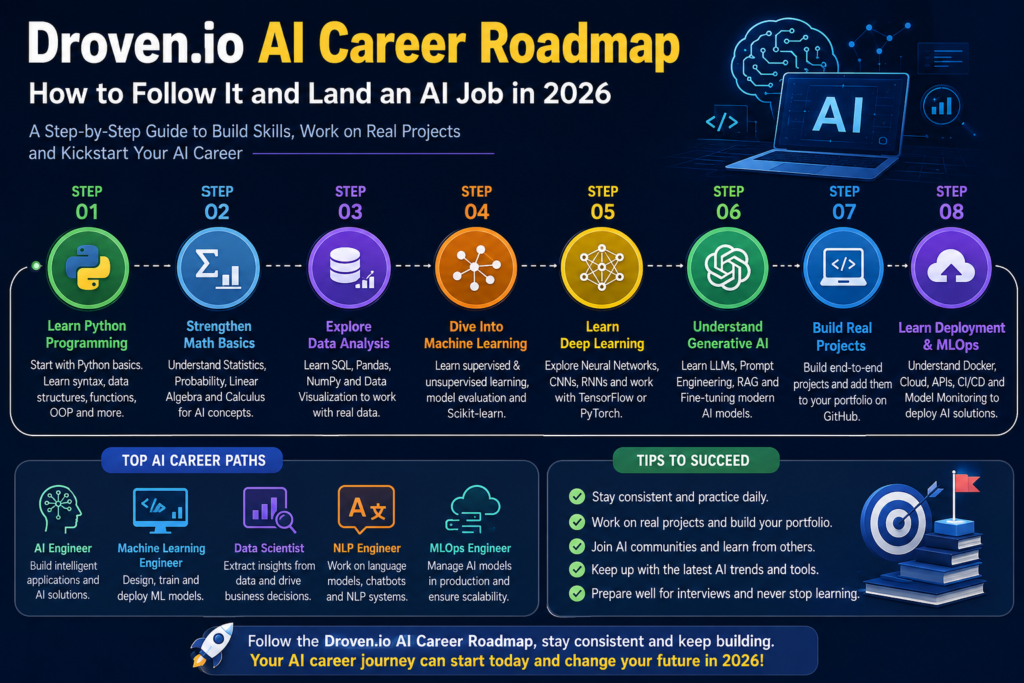
Step 1: Learn Python Programming
If there’s one programming language you should prioritize, it’s Python.
Python has become the preferred language for AI and machine learning because of its simplicity and extensive ecosystem of libraries. Most AI tools and frameworks are designed with Python support in mind.
Start by learning:
- Variables and data types
- Loops and conditional statements
- Functions and modules
- Object-oriented programming basics
- File handling and exception management
The goal isn’t to become a software engineering expert overnight. Instead, focus on becoming comfortable enough to write and understand code confidently.
Step 2: Strengthen Your Mathematical Foundations
Many people are intimidated by the mathematical side of AI, but you don’t need a PhD to get started.
That said, understanding a few core concepts can make machine learning much easier to grasp.
Important areas include:
Statistics and Probability
These concepts help you understand how models make predictions and how data behaves.
Linear Algebra
Vectors, matrices, and matrix operations form the backbone of many machine learning algorithms.
Calculus
While advanced calculus isn’t always necessary, understanding derivatives can help when studying optimization techniques used in deep learning.
Remember, the goal is practical understanding rather than academic perfection.
Step 3: Explore Data Analysis
Before machines can learn from data, that data needs to be organized, cleaned, and analyzed.
This is where data analysis skills become valuable.
Tools worth learning include:
- Pandas for data manipulation
- NumPy for numerical computing
- Matplotlib for visualization
- SQL for working with databases
Being able to extract insights from raw datasets is a skill that many employers actively seek.
Step 4: Dive Into Machine Learning
Once you’ve built your foundation, it’s time to explore machine learning.
Machine learning teaches computers to identify patterns and make decisions based on data.
Some key concepts to learn are:
Supervised Learning
Models are trained using labeled data to make predictions.
Examples include:
- Spam email detection
- House price prediction
- Customer churn analysis
Unsupervised Learning
Models identify patterns in data without predefined labels.
Examples include:
- Customer segmentation
- Market basket analysis
Model Evaluation
Understanding metrics such as accuracy, precision, recall, and F1-score is essential when assessing model performance.
Libraries like Scikit-learn can help you apply these concepts in real projects.
Step 5: Learn Deep Learning
Deep learning has powered some of the most exciting advancements in AI, including image recognition and natural language processing.
As you progress, consider learning:
- Artificial neural networks
- Convolutional Neural Networks (CNNs)
- Recurrent Neural Networks (RNNs)
- TensorFlow
- PyTorch
While deep learning may seem intimidating at first, many learners find it easier once they’ve mastered traditional machine learning concepts.
Step 6: Understand Generative AI
In recent years, generative AI has become one of the fastest-growing areas within technology.
Employers increasingly value professionals who understand modern AI applications.
Topics worth exploring include:
- Large Language Models (LLMs)
- Prompt engineering
- AI assistants and chatbots
- Retrieval-Augmented Generation (RAG)
- Fine-tuning AI models
Having knowledge of these emerging technologies can give you a competitive advantage in the job market.
Step 7: Build Real Projects
This is the step many learners skip—and it’s often the reason they struggle to find jobs.
Employers don’t just want certificates. They want evidence that you can apply your skills.
Some project ideas include:
- Movie recommendation systems
- Sentiment analysis tools
- Image classification applications
- Resume screening systems
- Customer support chatbots
Upload your projects to GitHub and document your learning process. A strong portfolio can often outweigh formal credentials.
Step 8: Learn Deployment and MLOps
Creating a machine learning model is only part of the job. In professional environments, models need to be deployed and maintained.
Important skills include:
- Docker fundamentals
- API development
- Cloud platforms like AWS or Google Cloud
- CI/CD concepts
- Model monitoring practices
These skills can significantly increase your employability, especially for machine learning engineering roles.
AI Career Paths You Can Pursue
Following the Droven.io AI Career Roadmap can prepare you for several exciting opportunities.
AI Engineer
AI engineers build intelligent systems that solve real-world problems.
Machine Learning Engineer
These professionals design, train, and deploy machine learning models.
Data Scientist
Data scientists analyze information to uncover trends and support decision-making.
NLP Engineer
NLP specialists focus on language-based technologies such as chatbots and translation systems.
MLOps Engineer
MLOps engineers ensure AI systems operate efficiently in production environments.
Each path requires a slightly different skill set, so choose one that aligns with your interests.
Common Mistakes to Avoid
While following the roadmap, try to avoid these common pitfalls:
Skipping the Basics
Rushing into advanced topics without understanding fundamentals often leads to frustration.
Collecting Certificates Without Practice
Courses are valuable, but practical experience matters more.
Ignoring Soft Skills
Communication, teamwork, and problem-solving abilities are important in every technical role.
Comparing Yourself to Others
Everyone learns at a different pace. Focus on consistency rather than speed.
How Long Does It Take to Get an AI Job?
The timeline varies depending on your background and learning schedule.
For complete beginners, becoming job-ready may take 9 to 18 months of focused effort.
Individuals with programming or data analysis experience may progress more quickly.
The key factors influencing success include:
- Consistency
- Project experience
- Networking
- Interview preparation
There isn’t a universal timeline, but steady progress almost always yields results.
Final Thoughts
Breaking into artificial intelligence can feel overwhelming, especially when you’re unsure where to start. That’s why having a structured learning path is so valuable.
The Droven.io AI Career Roadmap offers a practical way to navigate the complexities of the field. By focusing on programming fundamentals, machine learning concepts, real-world projects, and emerging technologies, you can gradually build the confidence and expertise needed to pursue an AI career.
Remember that success in AI isn’t about learning everything at once. It’s about taking one step at a time, staying curious, and consistently applying what you learn.
If you remain committed to the process, 2026 could be the year you transition from AI enthusiast to AI professional.
Frequently Asked Questions
Is the Droven.io AI Career Roadmap suitable for beginners?
Yes. The roadmap is designed to guide learners through foundational concepts before moving into advanced topics.
Do I need a computer science degree to work in AI?
No. Many professionals enter the field through self-study, boot camps, and project-based learning.
Which programming language should I learn first?
Python is widely regarded as the best starting point for aspiring AI professionals.
How important are projects when applying for AI jobs?
Projects are extremely important because they demonstrate practical skills and problem-solving abilities.
Is AI still a good career choice in 2026?
Yes. Demand for AI talent continues to grow across industries, making it an attractive career path for many professionals.